
Two gradients run through every lit room, and they run in opposite directions. One is physical: photon flux falls as distance from the fixture grows, so the brightest tissue in the room is the tissue at the top of the canopy. The other is physiological: nutrients inside the plant are either movable or they are not, and that decides whether a shortage shows up on the oldest leaves or the newest ones. Together, those two gradients are the difference between light burn and a nutrient deficiency, and mixing them up is where most misdiagnoses start.
Overlay the two and you get the diagnostic situation growers actually face. A pale leaf at the top of a plant and a pale leaf at the bottom of the same plant can look like variations of one problem. They are not. They have different causes, different clocks, and different fixes, and the single most expensive mistake in a lit room is to treat the first as the second.
This guide is the diagnostic half of that claim. It gives you a five-row decoder for the conditions that look alike, the two readings that separate them before anyone touches the feed schedule, and the four symptoms that are not a lighting problem at all.
The Five-Second Triage
Before opening a nutrient bottle or turning a dial, answer three questions about the damaged tissue. They take a minute and they cut the candidate list by half.
- Where is it? Closest to the fixture, newest growth, oldest growth, or spread evenly across the plant.
- How fast did it arrive, and which way is it travelling? Over a weekend, or over a fortnight, and moving up from the bottom, outward from the growing points, or down from the fixture.
- Did the last feed change move it? A correction that shifted the symptom within a week is a nutrient answer. A correction that changed nothing is not.
Position and speed are the two cheapest signals in the room, and they are the two that most photo-based diagnosis skips. Colour is the least reliable of the three, because half a dozen unrelated conditions produce yellow.
Two Maps on One Plant
Why Bleaching Tracks Distance and Deficiency Tracks Mobility
Light damage follows the light. Bleaching, the condition growers call light burn, appears on the tissue closest to the emitter regardless of how old that tissue is, because what drives it is photon flux arriving faster than the photosynthetic apparatus can use it. When the flux exceeds what the plant can process, reactive oxygen species accumulate and break down chlorophyll, and the tissue loses its green. The plant-science literature names the underlying process photoinhibition, and what you see in the canopy is its result. The response is driven by the light's intensity and its spectral balance, not by the calendar.
Nutrient damage follows mobility. Plants move some elements freely and others not at all, and this is textbook plant physiology rather than a cannabis-specific rule:
- Mobile nutrients (nitrogen, phosphorus, potassium, magnesium) can be withdrawn from mature tissue and re-sent to growing points. When one runs short, the plant cannibalises older leaves to keep new growth alive, so symptoms surface at the bottom of the plant first.
- Immobile nutrients (calcium, boron, iron, manganese, zinc, copper) are locked into the tissue they were delivered to and travel only in the water stream. There is no reserve to draw on, so a shortage hits the newest growth and the growing tips first. Sulphur behaves as immobile in the short term, which is why sulphur shortage also shows at the top rather than the bottom.
The Filter, Not the Verdict
Position is a filter, not a diagnosis. Knowing that a symptom is on old leaves tells you it is one of four mobile elements; it does not tell you which one. Knowing it is on new growth tells you it is immobile, or that the delivery path is broken. Both are useful, and neither is a laboratory result.
One caution belongs here, because it is the most common misread in the whole exercise: a deficiency that appears on new growth does not prove the plant is short of anything. Immobile nutrients travel with water, so a delivery failure looks exactly like a shortage. Most apparent deficiencies are availability problems, and adding the nutrient to a medium that already carries it changes nothing.
The Symptom Decoder: Five Conditions, Read Two Ways
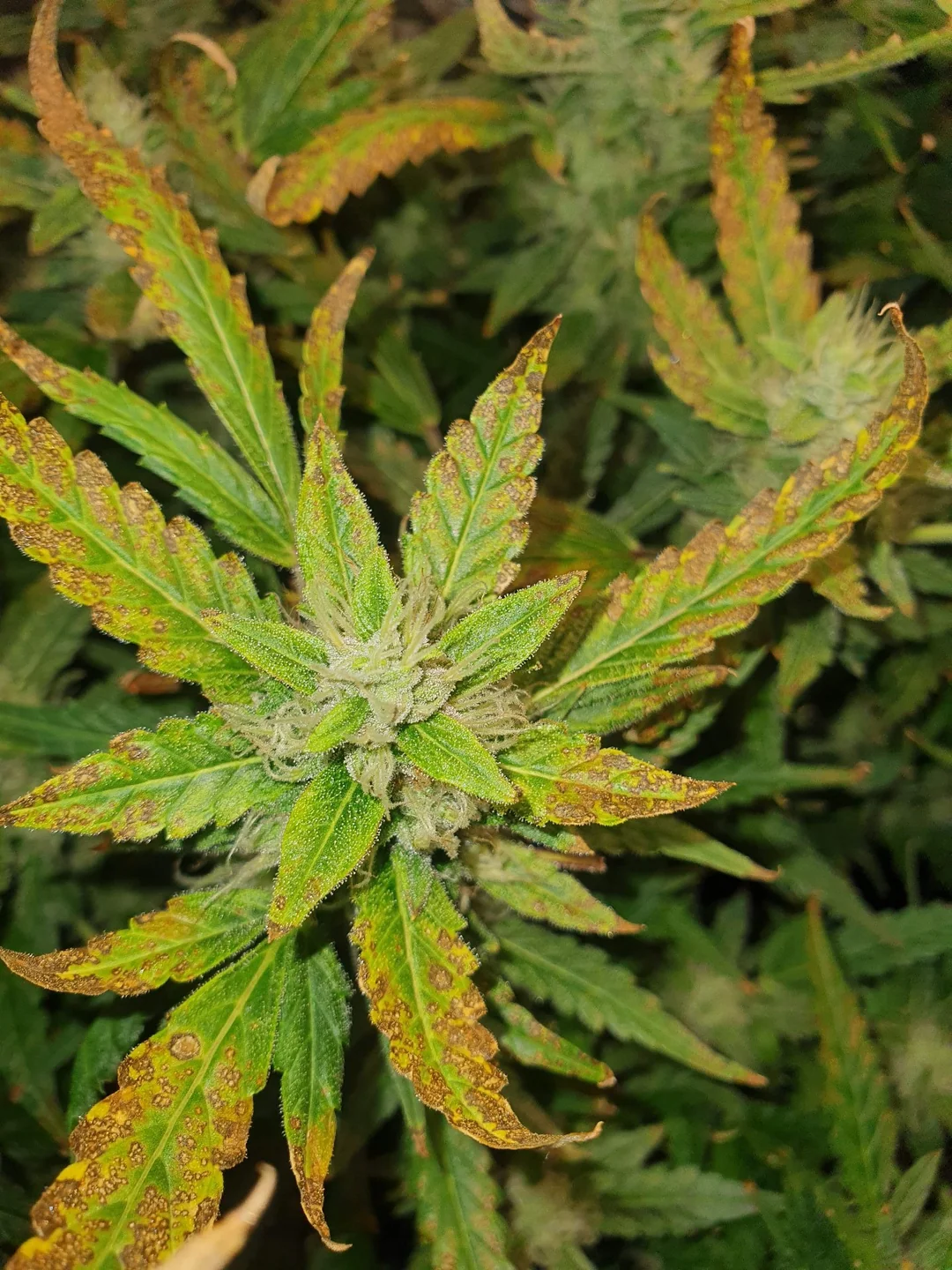
These are the five conditions that get confused with each other in a lit room. Read the row that matches your position, then check it against the speed and the feed response.
| Condition | Where It Starts | What It Looks Like | Speed | Responds To Feed? |
|---|---|---|---|---|
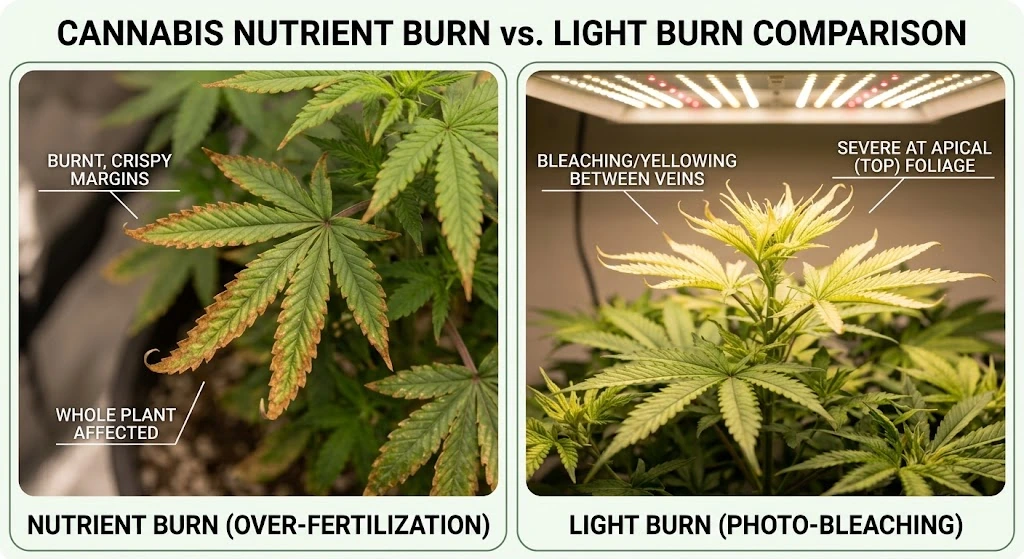
| Light burn (photobleaching) | Upper canopy, closest to the fixture, any leaf age | Tissue pales toward white, veins often last; leaves stay flat or angle upward; surface feels dry and crisp | 1 to 3 days | No |
| Heat stress | Upper canopy, in the still air under the fixture | Leaves cup or curl downward, margins brown, canopy wilts and recovers through the dark period | Hours to days | No |
| Nutrient excess (burn) | Newest growth, at leaf tips and margins | Brown or bronze crisp tips on a dark green leaf, tips clawing downward | About a week | Worsens with more feed |
| Mobile deficiency (N, P, K, Mg) | Oldest, lowest leaves | Uniform paling (N), dull dark or purple-tinted leaf (P), scorched margins (K), yellow between green veins (Mg) | 1 to 3 weeks | Yes, within days of a corrected feed |
| Immobile deficiency (Ca, B, Fe, Mn) | Newest growth and growing tips | Distorted or hooked new leaves, brown spotting on new tissue (Ca, B), sharp green veins on pale young leaves (Fe, Mn) | 1 to 3 weeks | Slowly, and only if the delivery path is fixed too |
Light burn and heat stress both hold the first two rows, which is exactly why position alone does not finish the job. The leaf posture separates them. Light damage bleaches without wilting, and it can appear in a room running perfectly normal air temperatures. Heat damage wilts, and the canopy usually looks better by the middle of the dark period, before the same zone stresses again the next light cycle. Radiant heat from a fixture and stalled air both raise leaf temperature without adding photons, and the two conditions can sit in one room at the same time. The reading that separates them is not the room thermometer but the leaf surface, which on a low-infrared LED fixture can sit at or below air temperature while the tissue in the beam bleaches.
Reading It Backwards: From Symptom to Verdict
The table above is indexed by condition, which is the view you want once you know what you are looking at. In a room you usually start at the other end, holding a symptom and asking which condition it belongs to. This version runs that way, and the two are meant to be used together: match the symptom here, then confirm it above against the speed and the feed response.
| What You Are Looking At | Fits Light | Fits Heat | Fits A Deficiency | Fits Both |
|---|---|---|---|---|
| Top leaves bleached toward white | Strong: the tissue nearest the fixture, whatever its age | Weak: excess leaf temperature wilts tissue rather than bleaching it | Weak: only an advanced mobile shortage reaches the top | Where the top of the canopy is also the highest-flux zone |
| Lowest leaves paling evenly | Unlikely: light does not reach the shaded interior evenly | Unlikely | Strong: a mobile element, nitrogen first | Rare, and only where the whole plant is already stressed |
| Yellow between the veins, newest leaves | Weak: bleaching is patchy rather than neatly interveinal | Weak | Strong: an immobile element, iron or manganese | Where new growth also faces the fixture |
| Yellow between the veins, older leaves | Weak | Weak | Strong: magnesium, which is mobile | Possible in a mixed stress |
| Leaf edges brown and crisp | Only at extreme top exposure | Strong: margins dry from the outside in | Strong: potassium on old foliage, calcium on young tissue | Common: edges scorch under either |
| New growth distorted, hooked, or brown at the tips | Weak: photons do not twist a new leaf | Weak | Strong: an immobile element, or a delivery path that has stopped | Where the tips also sit in the beam |
| Upper leaves curling upward into a taco | Strong: the leaf angles away from the flux | Possible, though a heat-stressed leaf usually cups downward instead | Weak: a shortage tends to droop | Under combined photon and leaf-temperature load |
| Canopy wilting through the middle of the light period | Weak | Strong, and it recovers by the middle of the dark period | Weak | Frequent: stalled air and high flux arrive together |
| Buds bleaching at the top of the canopy | Strong: the flowers sit closest to the emitter | Weak | Unlikely: a shortage rarely bleaches a bud directly | Rare, and the grade cost is the same either way |
One case is missing from this table on purpose. A plant that goes pale all at once, with no top-to-bottom direction at all, fits none of the columns cleanly, because the cause usually sits in the root zone, the water stream or the gas supply rather than in the light or the feed. That is the list of four further down this page.
The Two Measurements That Settle It
Position and posture narrow the field. Two readings close it, and neither one is the number printed on a bottle or a brochure.
Measurement One: A PPFD Map of Your Own Canopy
What you need is not the fixture's rated output but a grid of readings taken at canopy height in your own geometry. At minimum: directly under the centre of a fixture, in the gap between two fixtures, at the wall edge, and in the aisle. That is four readings per room and it takes about ten minutes.
What the map establishes is whether the damaged zone and the highest-flux zone are the same zone. They are not always. A room can carry a two-to-one gradient from centre to edge, and a fixture's published output says nothing about how its photons distribute once reflectors, distance and neighbouring fixtures are in the picture. Without the map, you are comparing a symptom you can see against a number you cannot.
Use a quantum sensor for this. Lux meters and phone apps are rough proxies that systematically under-read full-spectrum LED, and a proxy that under-reads will tell you a room is safe when it is not. If the instrument question is new, the measurement chain in the 30 core terms explains what each class of instrument can and cannot settle.
Measurement Two: Root-Zone EC and pH
The second reading is the number in the reservoir or in the runoff from the pot, not the number on the mixing chart.
pH first. Most immobile micronutrients drop out of availability outside a fairly narrow band, and iron in particular is far more often a pH problem than a shortage. Iron is abundant in most media; above a certain pH it simply stops being chemically available to the root, and adding more iron does nothing until the pH moves.
EC second. Electrical conductivity records what the plant was actually offered, not what was mixed. A runoff reading that climbs across the week means salts are accumulating in the medium. A reading that falls means the plant is taking up more than it is being given. Neither pattern is visible from the label on the bottle.
Reading the Two Together
Put the two readings side by side and the four possible combinations each point at a different first move.
| PPFD In The Damaged Zone | Root-Zone EC And pH | Read It As | First Move |
|---|---|---|---|
| High, at the top of the room's range | Normal | Light-driven damage: intensity, distance or a red-heavy spectrum | Distance or dimming first, then review the spectrum's red share |
| High | Low or drifting | Demand lifted by intensity, or a delivery failure underneath | Correct the delivery, then re-map: this one is usually both |
| Within range | Low or drifting | A real nutritional shortfall | Correct the feed, then re-map to confirm the zone stayed clean |
| Within range | Normal | Neither light nor feed: transport, root function or antagonism | Go to the environmental list further down this page |
The order matters for a commercial reason. Every day spent adjusting the feed while the light is the cause is a day the top of the canopy keeps bleaching, and the top of the canopy is the most valuable material in the room. Take the two readings first; they are ten minutes of work against a fortnight of guessing.
Why Deficiency Appears After a Light Change
There is one pattern worth naming on its own, because it produces a textbook calcium deficiency in a room where the calcium was never short.
Calcium is immobile, and it moves only in the transpiration stream. It goes where the water goes. The newest tissue transpires the least and grows the fastest, so it depends on a steady upward flow to be supplied at all. Anything that slows that flow starves the growing tips first, with a full reservoir sitting underneath them.
Now swap HPS for LED. An HPS fixture delivers a large share of its energy as radiant heat, which raises leaf temperature above air temperature. A modern LED delivers very little of it, so leaf temperature sits at or slightly below air temperature instead. On the same setpoints, the canopy transpires less than it did under the old fixtures, and the tissue at the top of the plant is the first to notice. The symptom that shows up looks like a shortage and is a supply-rate problem.
Two consequences follow. First, dosing more calcium into a feed that already contains it is the classic wrong move: the calcium is present, it is simply not arriving. The levers are the ones that restore the water stream, which means airflow across the canopy, a humidity setpoint that is not so high it stalls transpiration, and irrigation timing that keeps the medium cycling rather than sitting wet. Second, the same logic applies to boron, which travels the same route. If the question is specifically why calcium and magnesium demand appears to rise under LED, the short answer is that reports from commercial rooms describe exactly that, the mechanism is still debated, and the transport path is the part that is not in doubt.
What Bleaching Actually Costs
The Chemistry Is Largely Intact, the Grade Is Not
The popular version of this story says bleached buds lose potency. The primary research says something more specific and less dramatic. A lighting manufacturer's own science team, reporting on photobleaching in cannabis, found cannabinoid and terpene content in bleached tissue matching unbleached bud, with terpene concentration occasionally coming back slightly higher. Where a heavily bleached crop did test lower, the team concluded the association was coincidental to the red-heavy spectrum rather than caused by the bleaching. That reading is consistent with the mechanism: there is no metabolic route by which chlorophyll breakdown would take cannabinoids with it. Bleached tissue is also a small share of the flower biomass.
What is not intact is the appearance, and that is where the money is. On a living plant, white tips read as frost and photograph beautifully, which is how the frosted-peak aesthetic spread through social media. Dried and trimmed, the same tissue reads beige to brown, and a buyer reads beige-brown as mould, decay or age. The buds that bleach are the ones at the top of the canopy, which is normally the highest-value material in the room.
So the cost of bleaching is a grade cost, not a chemistry cost. That distinction changes the fix: you are not protecting the molecule, you are protecting the top of the grade sheet and the buyer's first impression.
Two further points keep this honest. The response is strongly cultivar-dependent, and some cultivars bleach under otherwise ideal conditions, which makes a fixture choice and a cultivar choice part of the same decision. And chasing white tops is not a technique: no published trial supports the folklore that bleaching concentrates anything.
Dimming Is Not the Fix
The obvious response to bleaching is to turn the room down. It works, and it also charges you. Canopy response to added photons stays close to linear up to high intensity before it flattens, so every photon you pull back is production you do not recover. Reacting to bleaching by cutting intensity is paying twice: once in grade, once in growth.
The commercially sound responses, in order:
- Distance. Free, instant, reversible, and often enough on its own if the canopy grew into the fixture's near field.
- Distribution. Spread the same photon budget across more emitters and lower each one, so no single zone runs hot. This is a layout decision, and it tends to cost less than it saves.
- Spectrum. A broader base carries less red per photon, and red share is the part of bleaching risk a buyer can spec away from at order time rather than rescue later. The spectrum guide covers the band-level evidence.
- Intensity. Last, and only after the three above.
Switchable channels change the arithmetic here. If red is a controllable channel rather than a fixed share of the spectrum, you can hold red back through the stages where flower tissue is most sensitive, keep PPFD climbing through bulking, and bring red back as development slows. That is a purchase-time decision, not something a room can be talked into after the fact.
Four Symptoms That Are Not a Lighting Problem
The third category is the one that wastes the most time, because both the position test and the feed test come back inconclusive. In each of these four cases the visible symptom is real and the cause is somewhere else entirely.
A Broken Dark Period
Revegetation, single-blade leaves appearing on a flowering plant, stalled flower development, or male structures on a plant that should be female. It gets filed as a light problem because it appeared under the light, but the light cycle is not the trigger: an interrupted dark period is. Even a short pulse of light during the dark hours can be read by the plant as a night that was not long enough. This is a dark-period hygiene problem, and a green “safe” lamp still counts as a leak until you have measured it. The flowering switch and the light leak entry cover the mechanism and the checklist.
Transpiration Collapse
High humidity or still air stalls the water stream, and the immobile nutrients stop arriving at the newest growth. The reservoir is fine, the mixing chart is fine, and the plant still reads as deficient at the top. This is an environment problem with a nutrient symptom. The room terms guide carries the VPD bands and the transpiration relationship that explain it.
A Root Zone That Cannot Deliver
Waterlogged or cold medium, compacted substrate, and nutrient antagonism all produce textbook deficiency symptoms in a medium that is short of nothing. High potassium blocks magnesium uptake; high phosphorus blocks zinc and iron. In each case the element is present and unavailable, which is why the plant's appearance and the reservoir reading disagree. Test pH before dosing anything, and test root-zone function before testing the feed.
A Sealed Room That Ran Out of Carbon
In a sealed room without supplementation, carbon dioxide falls through the photoperiod as the canopy consumes it, and growth stalls under full light. Because it shows up under load, it gets read as light stress. It is a gas problem. The room terms guide covers drawdown and the supplementation bands.
The Order of Operations
This is the sequence that avoids the expensive mistake, and it is short enough to put on a room card. The mistake has a shape worth recognising, because it confirms itself: a scout reads bleaching at the top as a shortage, the feed goes up, EC climbs, the lower leaves start to pale as well, and that appears to confirm the first reading while the light keeps running.
- Photograph it and mark the position. Note the node level and which side of the canopy, because the next comparison depends on it.
- Map the canopy. Record PPFD at the damaged zone and at a healthy zone at the same height. Ten minutes.
- Read the root zone. pH first, then EC, from the reservoir or the runoff.
- Read the posture. Bleached and flat points at photons. Cupping and wilting point at leaf temperature. Distorted new growth points at an immobile nutrient or a broken delivery path.
- Change the reversible thing first. Distance or dimming can be undone before lunch. A feed change takes about two weeks to answer, so it is the last move, not the first.
- Write down what you changed and when. The next occurrence is the one you will want the record for, and a room with no history re-diagnoses the same problem every cycle.
Light Burn and Deficiency FAQ
How do I tell light burn from nutrient deficiency?
Start with position and speed. Light burn appears on the tissue closest to the fixture, whatever its age, usually within one to three days, and it does not improve when the feed changes. A nutrient deficiency follows nutrient mobility instead: it arrives over one to three weeks, and the newest growth responds first once the feed is corrected. Then confirm it with two readings, the PPFD at the damaged zone from a canopy map and the EC and pH at the root zone.
Why are my top leaves yellow while the bottom leaves stay green?
Because the two causes that hit the top leave the bottom alone. Photon flux is highest at the top, so light damage starts there. And the immobile nutrients, calcium, boron, iron, manganese, zinc and copper, cannot be moved out of the tissue they were delivered to, so a shortage of any of them shows on the newest growth first while the older leaves keep what they hold. Leaf posture separates the two: bleached and flat points at photons, distorted or hooked new leaves point at an immobile nutrient.
Why do my plants need more calcium under LED lights?
Commercial rooms consistently report calcium and magnesium demand rising after a conversion from HPS to LED, and the mechanism is still debated. What is not in doubt is transport: calcium is immobile and travels only in the transpiration stream, so it arrives wherever water arrives. Anything that slows transpiration, high humidity, still air or a shorter irrigation cycle, starves the fastest-growing tissue first even with a full reservoir. Check the delivery path before adding more calcium to a feed that already carries it.
Are bleached buds less potent?
The primary research says the chemistry is largely intact. A lighting manufacturer's own science team reported cannabinoid and terpene content in bleached tissue matching unbleached bud, with terpene concentration occasionally slightly higher, and concluded that cases of lower potency alongside heavy bleaching were coincidental to the red-heavy spectrum rather than caused by the bleaching itself. The loss is in appearance and grade. On the plant, white tips read as frost; dried and trimmed they read as beige to brown, which buyers associate with mould and decay.
Does light burn reduce yield?
Less than the appearance suggests. Bleached tissue is a small share of the flower biomass, and floral buds are carbon sinks that draw assimilate from leaves rather than fixing much themselves, so a bleached top removes little photosynthetic capacity. The commercial cost sits on the grade sheet, because the buds that bleach are the top of the canopy and the highest-value material in the room. The larger risk is the response: dimming the room to stop bleaching pulls photons that published canopy response curves suggest were still paying.
What is the difference between light burn and heat stress?
Both hit the top of the canopy, and they are driven by different things. Light burn is photon excess: tissue bleaches toward white, leaves stay flat or angle upward, and it can happen in a cool room because it does not require a high air temperature. Heat stress is leaf temperature excess: leaves cup or curl downward, margins brown, and the canopy wilts and recovers with the dark period. Radiant heat from a fixture and stalled air both raise leaf temperature without raising the photon count, which is why the two can appear in the same room at the same time.
Do I need a PAR meter to tell them apart?
Not to tell light damage from a deficiency, but you need one to act on it. A fixture's rated output says nothing about the flux in your own room, because distance, reflector geometry and the gaps between fixtures decide what the canopy actually receives. A quantum sensor gives you a PPFD reading grid at canopy height, which is what shows whether the damaged zone and the highest-flux zone are the same zone. Lux meters and phone apps are rough proxies that under-read full-spectrum LED.
Why do deficiency symptoms show up on new leaves instead of old ones?
Because those nutrients cannot be moved. Nitrogen, phosphorus, potassium and magnesium are phloem-mobile, so when they run short the plant withdraws them from older leaves to keep new growth going and the oldest leaves show it first. Calcium, boron, iron, manganese, zinc and copper are locked into the tissue they are delivered to, so the plant has no reserve to draw on and the newest growth suffers first. Sulphur behaves as immobile in the short term. That split halves the candidate list before you look at the leaf.
How long does light burn take to appear, and do the leaves recover?
Visible change usually follows within one to three days of a rise in intensity or a drop in distance, which is faster than any nutrient problem develops. Damaged tissue does not recover: bleached or crisped areas stay that way. The test is the new growth that follows your correction. If the new leaves come in green and flat, the cause was addressed. If the same zone bleaches again, the map and the root-zone readings have not yet agreed.
Do LED grow lights bleach plants more than HPS does?
Not because one source is intrinsically harder on plants, but because of the warning an LED does not give you. An LED fixture emits very little infrared, so the leaf surface stays at or below air temperature even under a high photon load, and nothing feels hot before the tissue bleaches. An HPS lamp delivers a large share of its energy as radiant heat, so the same mistake announces itself sooner through a warm leaf. What decides the outcome is the photon flux at the leaf and the temperature of the leaf surface, both measured rather than assumed. The fixture arithmetic behind the difference is in the LED versus HPS comparison in this section.
What Comes Next
Once the diagnosis is settled, the intensity question is the next one to close: the PPFD and DLI guide carries the targets by stage, and the efficacy guide explains what an µmol/J figure does and does not prove. If the symptom arrived after a fixture change, the retrofit guide in this section covers the room adjustments that follow. And if the question is whether the room was specified correctly in the first place, the LED versus HPS comparison runs the layout arithmetic.
Reading a Room That Keeps Bleaching?
Send us the room dimensions, the fixture list, the mounting height and your canopy PPFD readings: we will come back with a layout review and indicative pricing.