
Every facility buyer meets this comparison twice: once when planning a new room and once when an old room's numbers start sliding. The fixture side of the argument is older than LED itself, which is why the internet is full of conclusions drawn from 1,000-watt lamp brochures and 2015-era LED panels. This page runs the comparison the way a facility decision actually runs: in efficacy, in electricity, in cooling, in maintenance, in payback, and in the few cases where sodium still pencils. Every figure below is a practical planning range from published trials, monitored case studies or industry cost guides, not a guaranteed outcome.
LED vs HPS at a Glance
The comparison in one table. Each row is unpacked in the section below it:
| Factor | HPS (planning range) | LED (planning range) | What it changes |
|---|---|---|---|
| Fixture efficacy | 1.0–1.4 µmol/J single-ended; 1.7 the double-ended peak | 2.8–3.1 µmol/J mainstream at the wall | The gap every other row inherits: what µmol/J measures |
| Wall watts per photon target | baseline | roughly 40% fewer watts for the same photons | Electricity, conductor size, panel headroom |
| Flower per m² at the same PPFD | slight edge (low-blue sodium spectrum) | a few percent behind with whiter spectra, cultivar-dependent | A spectrum effect, not an efficiency effect |
| Flower per dollar of electricity | baseline | +25 to 30% | The number the bill is actually paid in |
| Heat into the room | proportional to wall watts, plus radiant infrared on the canopy | proportional to wall watts, which are ~40% lower | Cooling tonnage, dehumidification balance, vertical stacking |
| Lamp maintenance | re-lamp near 10,000 h; about 12–14 months in flower | none; verify L90 instead | A recurring line item versus a spec-sheet check |
| Ballast | external, 5–15% overhead, fails on its own schedule | built-in driver | Bypass scope on any retrofit |
| Fixture price (1,000 W class) | $200–400 per kit | $600–1,500 per fixture | The only row where HPS wins, and it does not survive the project view |
| Utility rebates | limited | DLC-listed fixtures commonly 25–50% covered | The fastest lever on payback: certifications |
The Efficacy Gap Is the Whole Comparison
Start with the number every other row inherits. Independent fixture testing in 2014 measured double-ended HPS at 1.66 to 1.70 µmol/J, the same bench that put single-ended lamps near 1.02, and that double-ended figure tied the best LED of its year. The tie is the hinge of the whole market: every year since, LED improved and the discharge design did not. Mainstream LED fixtures now quote 2.8 to 3.1 µmol/J at the wall, roughly 40% fewer wall watts for the same photon delivery, and the efficacy page shows the audit trail from diode grade to wall-plug figure.
Watch one trap when comparing quotes: the HPS number was always photons per lamp-watt, before the ballast paid its 5 to 15% overhead, while the LED number is stated at the wall. Add the ballast share back before putting a sodium figure next to a diode one. A quote that praises "1.7 µmol/J, same as the old flagship" is quoting a 2014 measurement as if time stopped.
Yield: Two Different Denominators
Here is where most vendor pages stop, and where the honest comparison starts. Flower yield and electricity are measured in different currencies, and the two technologies split them.
The controlled trial that matters ran hemp through three studies in five-chamber setups with everything constant except the light source. HPS, with the lowest blue fraction of any treatment at 4%, produced the most flower per square metre; the white-plus-red LED fixture gave up 4.6% of area yield while delivering 27% more flower per dollar of electricity. A 2025 commercial-scale study with interlighting found the same split: HPS led on light use efficiency in grams per mole, LED led on grams per kilowatt-hour by around 7%, with a small edge in THC production efficiency. The sodium lamp is, modestly, the better spectrometer's idea of a yield lamp; the LED is unambiguously the better business.
Read the fine print before quoting either number: the cannabinoid-concentration result in the controlled trial came from a CBD-dominant cultivar, so "no effect on potency" is weaker evidence than it looks, and area-yield differences at equal PPFD are spectrum effects that a red-enhanced LED channel can narrow. What no trial has shown is HPS winning the cost comparison, and cost is the denominator a facility lives on.
Heat and the HVAC Bill
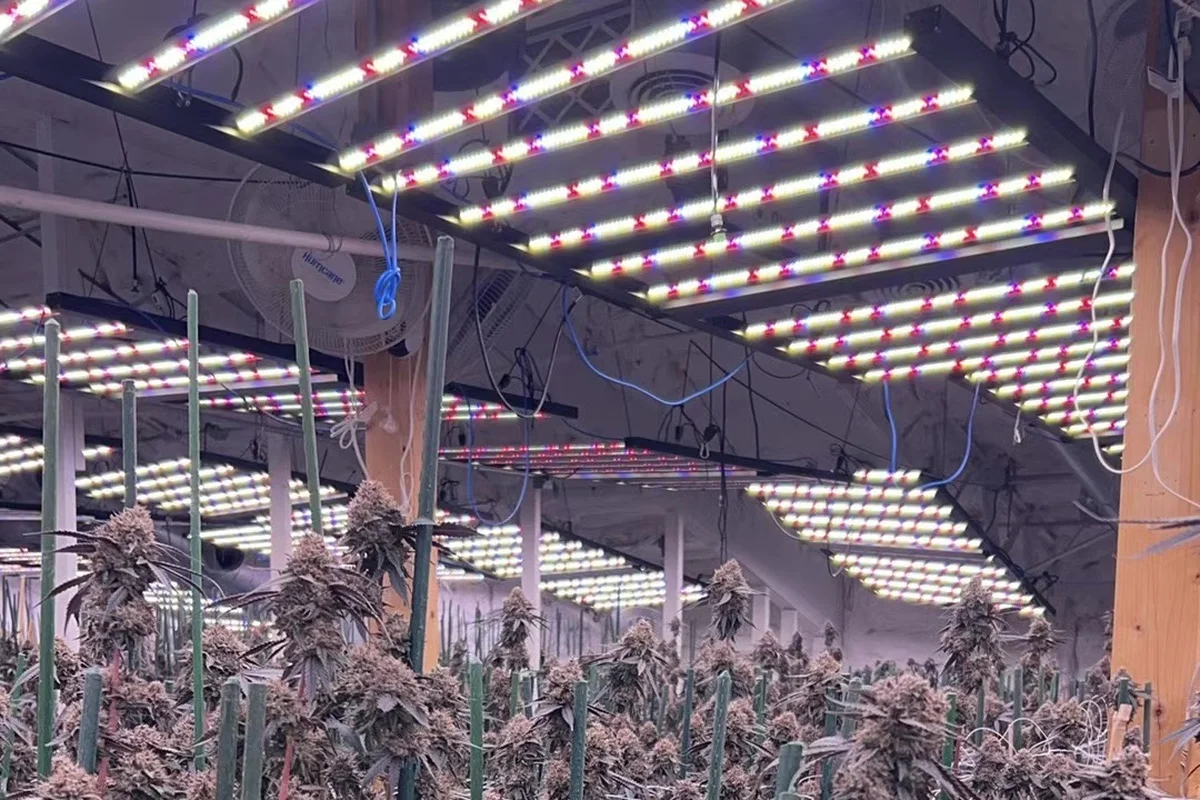
Heat is where the efficiency gap stops being a lighting number and becomes a building number. Every wall watt becomes 3.41 BTU per hour of heat regardless of what emits it, and moving that heat out costs roughly one watt of HVAC electricity for every three watts of heat, so a 40% lighting saving compounds into a larger climate saving on the same meter. One monitored head-to-head, two identical flower rooms run by a third-party metering firm for a full cycle, put it in whole-facility terms: lighting energy down 37%, and the entire facility including cooling, dehumidification and reheat down 25%, with HVAC-related savings accounting for over a third of the gap. The LED room also freed enough electrical capacity and cooling headroom to add an entire growing row under the same climate system.
Three details keep this honest. First, LED does not delete the climate system: a sealed room still needs dehumidification sized from the irrigation schedule, because transpiration drives the latent load whatever hangs over the canopy. Second, the radiant difference is real but easy to overstate: HPS infrared warms the leaf above air temperature while LED leaves run near air temperature, which shifts VPD setpoints and irrigation behaviour after a switch, a subject the grow-room glossary covers in full. Third, the heat you no longer add is capacity you can reuse: lower watt density per canopy is what makes multi-tier racks viable in rooms that could never have held a sodium ceiling height.
Maintenance: The Line Item LED Deletes
Sodium ownership ran on a calendar. Lamps were replaced near 10,000 hours on the industry rule that a 1% loss of light is a 1% loss of production, which a 12-hour flowering room reaches in 12 to 14 months; metal halide ran shorter still. Around the lamp lived the rest of the service schedule: ballast failures, reflector cleaning, and a lamp-disposal bill. None of these lines is large alone; together they are a permanent maintenance salary for the lighting system.
LED replaces the schedule with a specification check. The honest comparison is not a headline of hours against an interval; it is an L90 photon-maintenance figure with its projection temperature against a re-lamping line that renews forever. Ask for the L90 number and the temperature it was projected at, and the Part 1 lifetime entry explains what makes that figure defensible.
Upfront Cost, Payback and Rebates
The fixture sticker is the one row sodium wins, and industry cost guides still show the gap: a 1,000-watt double-ended HPS kit at a few hundred dollars against a comparable LED at several times that. The gap narrows the moment the comparison widens to the project, because fixtures are only 30 to 45% of a lighting budget; electrical infrastructure runs 20 to 35%, and HVAC modifications 5 to 15%. On the LED side of that wider ledger, fewer wall watts mean smaller conductors and freed panel capacity, the ballast rack disappears from the scope, and the re-lamping line item disappears from the operating budget.
Payback is where the ranges live, and they are wide because rates and hours differ. The whole calculation is one line: payback in months equals net investment, meaning fixture cost minus any rebate, divided by annual savings. Everything else in this section estimates those two inputs. Recent commercial projects cluster at 18 to 36 months, faster in high-rate territories and wherever a rebate lands. Utility programs are the fastest lever on the number, and most are gated by one practical requirement: the fixture must be on the DLC horticultural qualified products list, with qualifying projects commonly recovering 25 to 50% of fixture cost. Secure the utility's written pre-approval before the purchase order rather than after, because reserved budget is dependable while a retrospective application is discretionary. The certifications page shows the marks worth checking, and any payback quoted without a rate, an hours figure and a rebate assumption is marketing rather than math.
When HPS Still Makes Sense
A comparison page that lists no scenario for the losing technology is selling, not comparing. Four remain, honestly:
- Cold-climate greenhouses. Where the room needs heat most of the year, HPS radiant output is a heating asset wearing a lighting costume, and the waste heat offsets fuel that would be burned anyway. The economics are local and real: in high-latitude greenhouse modelling, a transition to LED cut lighting energy by about 40% while raising heating demand by 9 to 49%, for a net 10 to 25% off greenhouse energy use (Katzin, Marcelis and van Mourik 2021, Applied Energy).
- Exceptionally cheap electricity. The efficiency gap is worth money, and where the rate is very low, the money is small; a short horizon can fail to recover the fixture gap.
- Severe capital constraint. A facility that cannot fund the fixture premium at all chooses HPS the way it chooses a used truck: on available cash, not on lifetime cost.
- An existing fleet with years of life left. Where lamps and ballasts are healthy and the margin is not urgent, waiting is a strategy rather than inertia: that capital is already spent, and phasing the conversion room by room lets the next lamp order become the first payment instead of a fresh project. The retrofit playbook is built around that sequence.
Each window narrows every year as LED prices fall and efficacy rises, which is why the industry has already defaulted: new builds specify LED from day one, and the HPS conversation that remains is the retrofit one, which is a project scope rather than a fixture choice.
The decision in one grid, situation by situation:
| Situation | Lean | Why |
|---|---|---|
| New build or full refit | LED | No sodium assets to protect, and the room design assumes LED watt density |
| High-rate territory | LED | Electricity dominates the saving, so the switch pays back fastest |
| Heat-limited or stacked room | LED | Removing roughly 40% of lighting watts frees cooling tonnage and ceiling height |
| Existing HPS fleet with years left | Phase | The capital is already spent; convert at end-of-life, room by room |
| Cold-climate greenhouse | Calculate first | Waste heat offsets fuel you would otherwise burn |
| Very low commercial rate | Phase or wait | The efficiency gap is worth less money where power is cheap |
Three Comparisons That Get Fudged
Most bad LED-versus-HPS arguments are one of these three slides:
| The fudge | What is actually being compared |
|---|---|
| "1,000 watts versus 650 watts" | A lamp rating against a fixture rating. The HPS lamp draws its watts plus 5–15% ballast overhead; the LED figure is already at the wall. Compare wall to wall or photons to photons, never nameplate to nameplate. |
| "2.9 µmol/J beats 1.7" | Fixture efficacy versus delivered light. Efficacy only matters as photons on the canopy at your height: demand the PPFD map, not the sticker. |
| "LED yields more" / "HPS yields more" | Two different denominators. Per square metre at the same PPFD, sodium's low-blue spectrum holds a small edge; per dollar of electricity, LED wins by a wide and repeatable margin. State the denominator or the claim is noise. |
What to Ask Each Supplier
The comparison settles itself when both sides ship the same paperwork:
| Ask for | What it settles |
|---|---|
| Fixture efficacy in µmol/J at the wall | The efficiency gap, stated in the units the bill is paid in |
| A PPFD map at your mounting height and dimensions | Delivered photons, not brochure photons: how to read one |
| L90 photon maintenance with projection temperature | Whether "long life" survives contact with your room |
| DLC horticultural listing | Rebate eligibility: which marks count |
| A retrofit scope with the bypass priced from panel photos | Whether the switch is a project or a lamp swap: what the scope includes |
FAQ
Do LEDs yield less flower per square metre than HPS?
At the same PPFD, a whiter LED spectrum can yield slightly less flower per square metre than HPS; one controlled trial measured about 4.6% less under a white-plus-red fixture, and a 2025 commercial-scale study found HPS ahead on grams per mole. The same trials show LED ahead by 25 to 30% on yield per dollar of electricity. One number is a spectrum effect, the other an efficiency effect, and the bill is paid in the second currency.
How much electricity does switching from HPS to LED save?
Lighting energy drops 30 to 50% for the same photon delivery, because mainstream LED runs 2.8 to 3.1 umol/J against roughly 1.7 for double-ended HPS. Cooling drops with it: in a monitored head-to-head of two identical flower rooms, lighting energy fell 37% and the whole facility, HVAC included, fell 25%. Plan in ranges and verify with a PPFD map at your mounting height.
Does lower LED heat really shrink the HVAC system?
Every wall watt becomes 3.41 BTU per hour of heat regardless of the fixture, so cutting lighting watts by 40% cuts the heat by the same 40%, and removing heat costs roughly one watt of HVAC electricity for every three watts of heat. That is how a lighting saving compounds into a larger climate saving. What LED does not do is delete the climate system: a sealed room still needs dehumidification sized from the irrigation schedule, because transpiration, not the fixture, drives the latent load.
How often do HPS lamps need replacing compared with LED?
Commercial practice replaces HPS lamps near 10,000 hours on the rule that a 1% loss of light is a 1% loss of production; a 12-hour flowering room hits that interval in 12 to 14 months, and the ballast adds its own failure line. LED carries no lamp budget at all. The honest comparison is not 50,000 hours against 10,000; it is the L90 photon-maintenance figure at a stated temperature against an annual re-lamping line that never ends.
What does an HPS-to-LED switch cost upfront?
A 1,000-watt double-ended HPS kit can be had for a few hundred dollars, while a comparable LED fixture runs several times that, and fixtures are only 30 to 45% of a project budget once electrical work, controls and HVAC modifications are counted. The LED side claws money back in the same project: fewer circuits and smaller conductors for the same photons, no ballast racks, and utility rebates that commonly cover a quarter to half of qualifying fixture cost for DLC-listed products.
How long is the payback period on an LED switch?
Planning ranges across recent commercial projects cluster at 18 to 36 months, driven by three inputs: your electricity rate, your operating hours, and whether a rebate applies. The higher the rate and the longer the photoperiod, the faster the switch pays. Treat any payback quoted without those three numbers as marketing, and build the model from your own wall watts before believing anyone's default.
Is HPS still a reasonable choice in any scenario?
Four remain. In cold-climate greenhouses, HPS radiant heat is a winter heating asset rather than a liability. Where commercial electricity is exceptionally cheap, the efficiency gap buys less. A facility under severe capital constraint with a short horizon can still pencil HPS. And a fleet whose lamps and ballasts have years of life left can convert at end-of-life, room by room, instead of writing off working capital. Each of these windows narrows every year as LED prices fall and efficacy rises, so judge them against your own rates rather than habit.
Can I keep my HPS ballasts and just swap in LED retrofit lamps?
No. There is no LED tube that honours an HPS ballast curve; the retrofit path is a ballast bypass, disconnecting the old gear so the LED fixture feeds from line voltage through its own driver. Conversion bulbs were a discharge-era bridge between lamp families, and the solid-state equivalent of that trick does not exist. Price the bypass as electrical scope, not as a lamp swap.
What should I ask an LED supplier to prove the HPS comparison?
Five documents settle it: fixture efficacy in umol/J measured at the wall, a PPFD map run at your mounting height and room dimensions, an L90 photon-maintenance figure with the temperature it was projected at, the DLC horticultural listing that gates utility rebates, and a retrofit scope that names the electrical work, including the bypass, from photos of your panel. A supplier who ships all five is comparing fixtures; one who quotes watts and lumens is comparing brochures.
What Comes Next
If the comparison is settled and the room is already sodium, the next document is the retrofit playbook: photometric survey, electrical scope, and a dimming ramp-in plan that protects the crop during the changeover. If you are still comparing on the numbers, the efficacy guide shows how the headline figure is audited, and the PPFD and DLI guide turns a fixture choice into stage-by-stage targets for your own room.
Comparing Quotes Right Now?
Send both spec sheets: we will mark every line worth questioning and return a like-for-like photon comparison with indicative pricing.